

Creating energy certainty in a unpredictable market.
Artikel door

Frank Heijckmann
Sales Development Director
June 24, 2026

%201.png)
Energy certainty in an unpredictable market: why control over your energy supply matters more than ever
By Willem van der Heijden - Business Development Manager
The energy market is evolving—sometimes gradually, often abruptly. Increasingly, businesses no longer view it as a secondary concern, but as a direct influence on their daily operations.
The past few years have made this unmistakably clear. Covid disrupted global supply chains. The war in Ukraine drove gas and oil prices sharply upward. And ongoing geopolitical tensions remind us that new disruptions are never far away. These events are often labelled “Black Swan” events: rare, difficult to predict, and high in impact.
For energy-intensive businesses, that impact cannot be ignored. It is reflected in the price per kWh, in network costs, in transport expenses, and in tightening margins. It also shows up as growing uncertainty about what lies ahead.
The question is no longer whether such shocks will continue. The real question is how you respond.
The shift is being driven by several factors:
- Geopolitical tensions affecting oil and gas prices
- Increasing electrification across transport and logistics
- Grid congestion slowing growth and expansion
- CO₂ levies making fossil energy structurally more expensive
- Evolving revenue models and subsidy schemes
The difficulty with Black Swan events is not only their impact, but where that impact lands.
In logistics real estate, you see it through the tenants.
When energy demand rises:
- tenants’ operating costs increase
- pressure grows on rents and margins
- energy is not always available when it is needed
- investment decisions are delayed
- demand for predictable energy costs increases
That directly affects the attractiveness of a location. As a property owner, you cannot influence the cause. But you do feel it in the market response.
What we see in practice
The role of energy is shifting quickly. Where location and floor area once dominated decision-making, energy now plays a much larger part. Tenants are looking more closely at availability, capacity and cost. That is leading to a clear movement in the market: From property without an active energy strategy to property with integrated energy solutions. Not because it sounds good, but because it works.
Reducing dependency: property that moves with you
For logistics real estate, this creates a real opportunity. By generating your own energy, storing it and managing it intelligently, you gain more control over what happens on site. It reduces dependence on the electricity grid and gives you more control over cost and capacity. That allows your property to move with your ambitions.
Solar power as a logical next step
It starts with local generation. Large roof surfaces make logistics real estate particularly well suited to solar power. Yet the value extends beyond sustainability alone.
For managers and developers, solar energy provides greater control over on-site supply, reduces dependence on grid capacity, and helps create more stable energy costs for tenants. It can also generate additional revenue through schemes such as ERE. With ERE rates of €0.24 per kWh and above, the financial case is becoming increasingly attractive. Solar power strengthens not only the building, but the business case as well. Energy storage makes property more flexible.
The next step is energy storage.
Battery systems make it possible to distribute energy more intelligently throughout the day, creating clear advantages for real estate. Peak demand can be reduced, while grid connections and on-site generation are used more efficiently. Capacity can be shared more effectively across multiple tenants, increasing overall flexibility.
For sites with multiple users, that is essential. It creates room for growth without making you immediately dependent on a grid reinforcement. Combined with an energy management system, this creates an actively managed energy system within the property. This is how room for growth is created.
External factors remain, but their impact can change
The world will keep moving:
Geopolitical tensions, CO2 pricing, pressure on infrastructure and changes in legislation, these factors are not going away. But their effect on your property can change. By generating and storing power locally, you shift the dependency.
By managing energy intelligently, you create greater balance. You do not remove risk altogether. You make it smaller and, above all, manageable.
Developing and managing with energy as a foundation
For developers, this means considering energy from the very first sketch—not as an add-on, but as an integral part of the design. For managers, it means optimising existing assets and preparing them for future demand. In both cases, the goal is the same: to ensure the building continues to perform, whatever happens in the market.
From uncertainty to continuity
In logistics real estate, everything depends on movement. Goods must keep flowing and operations must continue without interruption. Energy plays a quiet yet crucial role in enabling this.
When energy supply becomes part of your strategy, it strengthens the position of your property, supports your tenants, and creates greater predictability. Not by controlling everything yourself, but by reducing dependence on what you cannot control.
Looking ahead
The energy market will continue to change—that much is certain. For logistics real estate managers and developers, the opportunity lies in how you respond. Not by waiting, but by looking ahead. Not by trying to avoid every risk, but by actively reducing it. By bringing together generation, storage and intelligent control, energy shifts from an uncertain factor to a stable foundation. This ensures your property continues to do what it is designed to do—day after day.
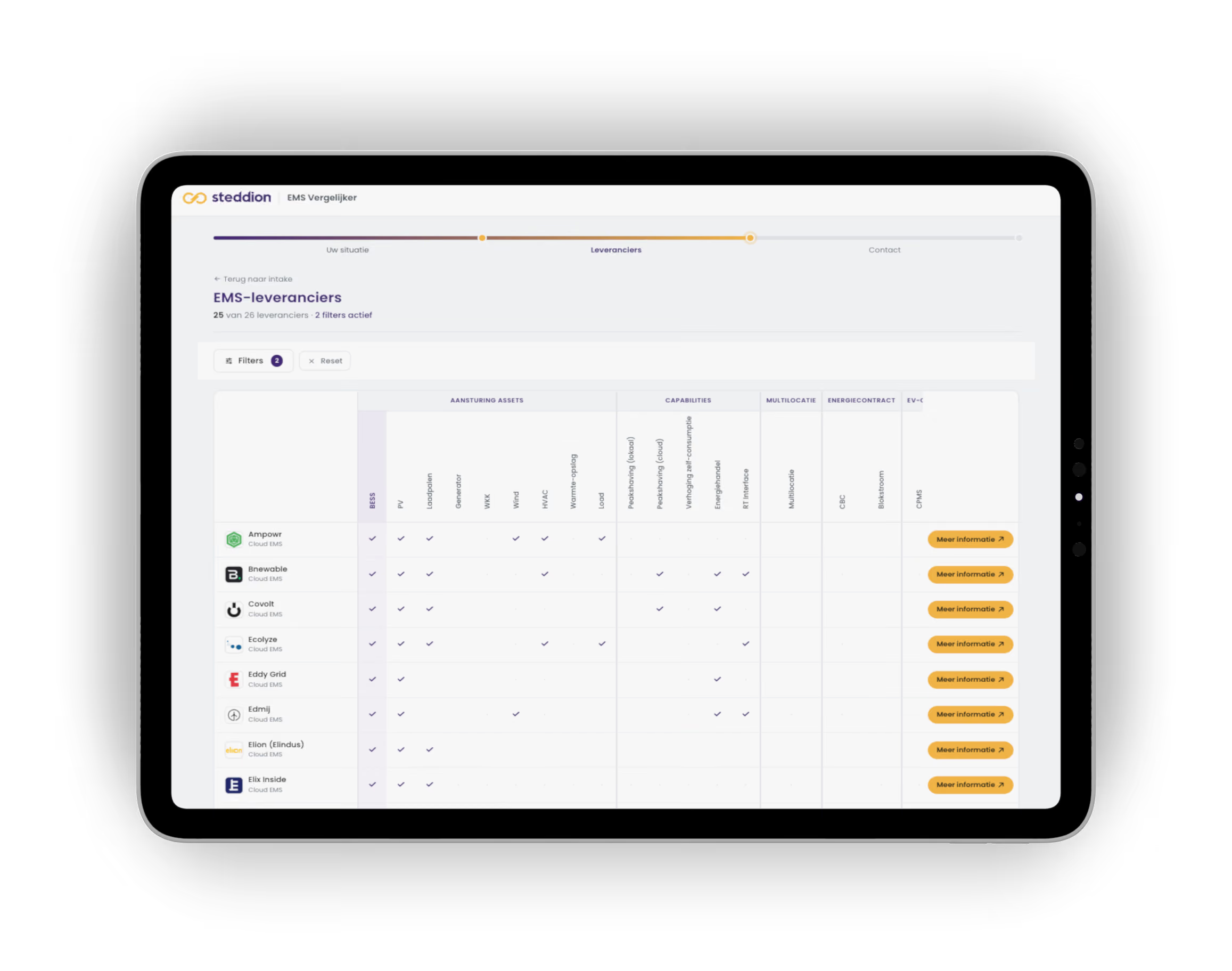
Vind en vergelijk EMS-systemen die bij jouw organisatie passen.